The Project
Bring on the pancakes!
A team of Stockton faculty members has been awarded three three-year United States Department of Agriculture grants to promote maple sugaring in the South Jersey region through research and community outreach.
The Stockton grant involves using modern technologies such as reverse osmosis, and vacuum assist pumps to implement an extensive sapping system on Stockton’s 1,600-acre main campus. Initial sample tapping began in February 2021on red maples, which have a lower sugar content than sugar maples, but are plentiful in South Jersey.
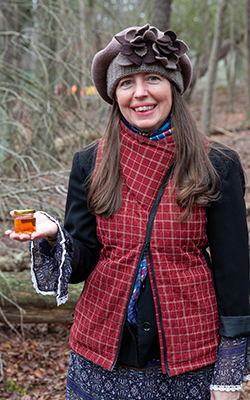 In addition, the grant is establishing a community outreach program of traditional
tapping methods on individual properties in the South Jersey area.
In addition, the grant is establishing a community outreach program of traditional
tapping methods on individual properties in the South Jersey area.
The project team is here to support residents who have access to multiple red maple trees and are willing to invest the time to collect and process the sap into syrup. The trees should be at least 10-inches in diameter.
Materials and training will be provided. Participants keep the syrup and are asked to record yields and allow a Stockton research assistant to collect soil and vegetation samples from the property.
The Stockton team brings together individuals with expertise in forestry, soil science, economics, and biodiversity. The members are Stockton Professor of Mathematics Judith Vogel, Assistant Professor of Environmental Science Jessica Favorito, Instructor of Economics Mariam Majd and Assistant Professor of Environmental Science Matthew Olson.
The tapping process is simple: a hole is drilled into a tree high enough so that gravity will help the sap flow down. A tap is inserted into the tree, and a tube is run into a food-safe container to collect the sap, which is later boiled down to make syrup.
Three years of data will be collected, and the Stockton faculty will use the data to investigate the science and economic potential of a maple syrup industry in non-traditional syrup production regions, such as southern New Jersey. They will also research the environmental impact of the tapping on the trees and local wildlife.
Maple-sugaring operations have never developed in South Jersey due to the relative rarity of sugar maple trees (Acer saccharum) and shorter duration of freeze-thaw cycling necessary to draw sap from trees. Ideal weather conditions are an overnight freeze, following by above-freezing temperatures during the day.
These same regions do have an abundance of other maple species (e.g., Acer rubrum). Although red maple sap contains half the sugar content of sugar maple, the use of modern technology —including vacuum assist sap pumps, reverse osmosis, and highly efficient evaporators—is now available to draw additional sap from trees and concentrate sugar with greater ease than previously known.
Vogel, whose family already makes maple syrup, said she hopes other residents will develop an interest in maple syrup production.
“We hope landowners get the bug to do this and promote maple syrup production," Vogel said.
Community members interested in participating in the pilot program can contact: mapleproject@stockton.edu
Diane D’Amico
Director of News and Media Relations