The Next Frontier of Medicine | Jennifer Fogarty '95 is helping prepare humans for deep-space travel while reimagining healthcare on Earth.


What happens if there’s a medical emergency in outer space?
Jennifer Fogarty ’95 has spent much of her career tackling these kinds of complex problems without easy answers.
“In space, there is no MRI, so I ask what other ways can we do this? There are different ways of solving medical problems. It’s become my passion to build test beds and work with commercial space to test and validate solutions,” she said.
Fogarty grew up in Northfield, NJ, with an early love of science and plans to become a doctor. At Stockton, where she earned a degree in Biology with a minor in Chemistry, that interest began to broaden. Courses across the sciences and liberal arts challenged her to look beyond the obvious answer — an approach that would become central to her career.
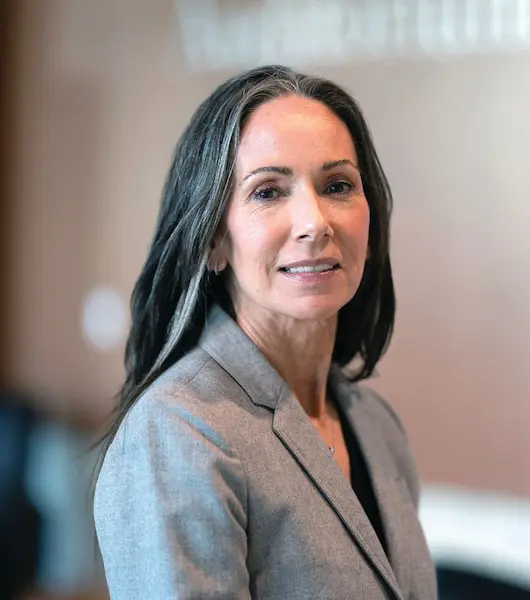
Jennifer Fogarty ’95, chief scientist at the Center for Aerospace and Extreme Environments Medicine, University of Central Florida College of Medicine.
That kind of problem-solving has taken Fogarty from South Jersey to the forefront of aerospace medicine. After earning her doctorate from Texas A&M University, she spent much of her career at NASA focused on astronaut health, including serving as chief scientist for its Human Research Program.
Today, she is chief scientist for the Center for Aerospace and Extreme Environments Medicine at the University of Central Florida’s College of Medicine, where she is helping build its aerospace medicine program.
When planning medical care for space missions, every item has to earn its place.
Fogarty calls it the “backpack problem”: just as hikers carry only what they truly need, space crews have to make difficult choices about what to bring and what to leave behind.
“I’ve sat at board tables where I’ve been asked how much food and water do you not want to take to fit medical supplies,” she recalled.
When looking into the future, Fogarty envisions someone holding a small device that can read and comprehend human vital signs and then transmit data for a diagnosis.
“Human bodies have an elegant series of sensors internally. The body gives signals, but we need a receiver to read them,” she explained.
Heart rate, body temperature, respiratory rate, blood pressure, blood sugar and electrical activity in the brain are all health indicators that can be evaluated to make a diagnosis.
Building a hand-held receiver with accuracy, sensitivity and portability is where research and development is focused.
“Artificial intelligence can be used as a tool to maximize how we analyze data, but critical thinking by humans is still needed to synthesize the information,” she explained.

A view of Earth from NASA’s Orion spacecraft is special to Fogarty, who helped develop Orion from its inception. Seeing the spacecraft carry astronauts into space marked a milestone in her career. Photo: NASA
The demands of spaceflight are driving the technology, but its potential reaches far beyond space. A portable diagnostic tool could expand access to care in remote or underserved areas where medical resources are limited.
“Spaceflight forced it. Then we can show hospitals what’s possible,” Fogarty said.
The past year has been exciting and challenging as Fogarty and her family and four rescue dogs relocated to Florida.
It also brought a career milestone decades in the making. When Fogarty’s now-18-year-old son was an infant, she was part of a team developing the medical requirements for Orion, the spacecraft used for NASA’s Artemis lunar exploration program.
This spring, she watched as Orion carried four astronauts around the Moon and back.
“It would be unsafe to go straight to Mars. Artemis II was inspirational and the right step, and I much appreciated the crew,” she said.
After a career spent navigating questions without simple answers, Fogarty now wants to help others develop the skills to do the same. She is developing an online course called “Scientific Critical Thinking,” which will be available worldwide in fall 2027.
For Fogarty, scientific critical thinking is less about chasing a single right answer and more about making well-informed decisions. It is a skill she hopes never becomes a “lost art.”
“Sound bites can be dangerous. They are not wrong, and they are not right. Details matter,” she said.
Looking back, Fogarty credits her Stockton education with helping her become a lifelong learner, critical thinker and someone who can adapt to change — skills that have served her throughout a career built around questions without easy answers.
“The value of a liberal arts degree is underestimated,” she said.
Previous:
Back to Issue Home
Stockton is the official magazine of Stockton University and is published by the Division of University Advancement.
The magazine is produced through the collaborative efforts of our editors, designers, writers, photographers, and advancement leadership.
Stay connected with Stockton. Update your alumni information to make sure you receive future issues of Stockton magazine and other university news.